|
|
|
Five months after the contract with the Spanish partner ended, Tan Hoang Minh signed another contract exporting rattan products valued at US$250,000 with a Turkish company. In HCM City, the Nha May (Rattan House) Supermarket situated on Ba Thang Hai Street (with a 1,500m2 surface) was inaugurated on June 8, 2002. A similar supermarket will be opened in Hanoi next month.
Ratex is now toddling into the domestic market. In HCM City, there are many big shops selling rattan furnishings on Nam Ky Khoi Nghia, Nguyen Thi Minh Khai, Dien Bien Phu streets and at Tan Son Nhat Airport, but none carries every item intended for the living-room, the kitchen, the bedroom and the study room sufficiently. As there is not a wide range of models and styles, the customer has little choice and usually has to order his items custom-made.
Tan Hoang Minh does not open scatter retail shops, but instead invests in a supermarket with 200 varieties of products ranging from furniture, conference tables, beds, closets to flower-vases, book-shelves, shoe-cases, etc. There are large tables using bent rattan, so well-treated that it's hard to discover the joints. Different from a number of rattan furnishings glowing with a bright amber color now in use in a few hotels, a majority of rattan articles at Nha May Supermarket is painted over with colorless varnish that shows the wood veins and natural designs. According to Dung, European customers now prefer rattan products with colorless varnish, but the company would readily meet any request for bright yellow rattan articles.
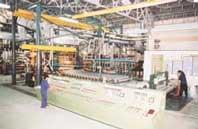
Rattan furniture has a unique beauty. The light elegance of a living-room set, or a rattan bed, rattan cradle, even a rattan pillow would entice us to a life in proximity with nature. However, in industrialized cities, where wooden furnishings are prevailing, is it possible for rattan products to compete? As far as endurance is concerned, wooden furniture may last many years, while rattan items have a maximum life of ten years. The life span of rattan goods will further depend on the technology treating the rattan itself. Upon its arrival at Ratex factory, the plant is "steamed" for six hours in a row so that it may swell to the maximum and be curved in whichever way possible. This steaming process not only keeps the internal structure of the rattan, but will also help it fight termites, and increase its endurance through all climatic conditions. The next stage in the production of rattan goods is the technique of framing, joint-fitting and knitting. At Ratex, only 5% of the production process is mechanized, mainly for rattan smoothing and polishing, the rest is done by hand. Therefore, the cost of a finished rattan product usually includes 35-40% labor cost.
Rattan furniture began to attract investment for concentrated production in Vietnam after the Swedish Corporation "Ikea" and a number of Spanish companies opened three factories in Khanh Hoa a few years ago. All of the products of these foreign-invested enterprises are exported. The domestic market is ignored because the price of rattan goods in foreign countries, determined by the distribution network of Ikea or the Spanish companies, is much higher than Vietnam's local price.
Do Anh Dung informed, "In Turkey, where we just signed a contract for export, the quality and designs of Vietnamese rattan articles are evaluated as equal to those made in the Philippines and Nicaragua, the world-leading countries in rattan products. We believe Ratex rattan goods will win over our local customers." Armed with this belief, Tan Hoang Minh is hoping that the annual sale of rattan products in the domestic market will reach VND8-10 billion, which is not a small target for a new item and a new label in the business world