|
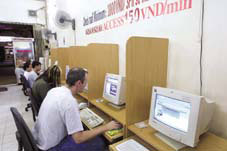
. the average
Internet charge is now down to just VND70 a minute, nearly equivalent to
that throughout the region. It is a little high mainly because of
telephone charges, as most Internet users in Vietnam hook up to the
Internet via telephone lines.
Statistics of the total number of Internet subscribers in Vietnam are
not consistent due to several services (subscription, prepaid cards,
Internet access through dialing VNN 1269, and so on) offered by ISPs.
Hoang Manh Cuong, vice head of the technology and planning division of
Netsoft (the provider of VNN Internet services in HCM City), says the
total number of Internet users in Vietnam is about 200,000. VNN holds
60% of the figure (some 120,000), FPT 30%, and SaigonNet and Netnam the
remainder. However, according to Truong Dinh Anh, director of FPT
(Internet), the company now has some 200,000 subscribers. Anh is
interested in Vietnam's Internet market. "The domestic Internet
market has great potential while the competition is not so harsh. With
an annual growth of 100%, there are many opportunities for ISPs to
develop," he says.
FPT is dynamic in taking new chances. Granted an IXP license in May this
year, the company will open two Internet gateways, 8MB each, in Hanoi
and HCM City in July. The total investment capital in the two gateways
is estimated to reach US$2 million, including optic cable and satellite
channels. As regulated by VNPT, all international links must be carried
out via channels leased from the Vietnam Telecommunication International
(VTI) under VNPT. Last year, the monthly rent for a 2MB international
channel was US$60,000; VTI reduced the rent to US$18,000 early this year
but according to FPT, "it is still three times higher than that in
regional countries." With such investment, FPT aims not only at
developing customer services but also leasing international channels to
other ISPs, Anh says.
The military telecom shareholding company Vietel, a heavyweight rival on
the local telecom market, also received an IXP license last month. The
company is now acting as an ISP to effectively offer local and
international VoIP (voice over Internet protocol) inexpensive telephone
services. Cuong from Netsoft says the competition on the Internet market
will be fiercer in the near future. As charges are low, companies
concerned will have to compete in improving quality and diversifying
services.
ISPs join the race. VNPT has an edge in the competition. As the national
telecom grid and postal service network are under VNPT's control, it
will have more favorable conditions than other competitors in terms of
serviceable and technological supply. VNPT is now providing high-speed
data transmission services, ISDN and ADSL, in HCM City on a trial basis
in preparation for an official nationwide launch in the near future. A
monopoly has allowed VNPT to offer services such as Internet access
through dialing VNN 1269 (for any telephone subscriber without
registering to hook up to the Internet) and ISDN and ADSL high-speed
data transmission, which cannot be supplied by other businesses.
Realizing the competition pressure from new opponents, however, Cuong
from Netsoft says, "We are never subjective. We have to
professionalize ourselves by steadily diversifying services and
improving managerial skills, along with reducing charges."
A long-time ISP, FPT has received a large number of clients. The company
is more confident since receiving an IXP license. Together with the
struggle against the monopoly, FPT is negotiating with new ISPs to
attract more potential customers. About 10 new ISPs are still waiting
for any market change and VNPT's price policy in the future. Some are
preparing their own business strategies. QTNet, a new ISP, provides
networking solutions for customers in export processing zones and
industrial parks. Tran Ngoc Duc, QTNet director, says his shareholding
company is cooperating with the HCM City Power Supply Co. to deliver
bills and collect money from their clients. Techcom, another new ISP, is
also ready for networking service supply. Tran Tho Nguyen, Techcom
director, says his company will focus on on-line services such as
virtual office, software and labor export, and teaching.
|