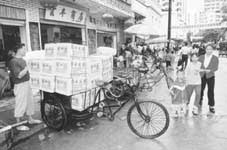
|
A
Huge Partner
China's entry into the World
Trade Organization (WTO) has created favorable
conditions for Vietnam's trade with this huge market.
However, the Vietnamese Government and businesses should
work out a particular strategy for doing business with
this 1.2-billion strong market.
By Thai Thanh
|
|
|
US$5
billion over the next five years.
According to Dao Ngoc Vinh, vice
director of the Asia-Pacific
Department of the Ministry of
Trade, Vietnam-China trade has
made astounding progress since
1991. The two countries have
signed more than 20 agreements
which have
|
|
|
provided
a fundamental legal corridor for trade
relations such as agreements on trade,
border trade, economic cooperation,
payment, and overland, air and railway
transport. Last year, two-way trade
reached a record high with US$2.5
billion, up 87.1% from 1999. China has
become Vietnam's fourth largest trading
partner after Japan, Singapore and
Taiwan.
Vinh attributes the increasing trade to
the determination to boost bilateral
trade and economic relations by top
leaders of the two countries, and
Vietnam's policies encouraging export to
China. The two countries have decided to
increase bilateral trade to US$5 billion
in the 2001-2005 period.
A multi-level market. Ho Quoc Phi,
Vietnamese trade counselor in Beijing,
says China is an easy market. This is
both an advantage and a shortcoming for
Vietnamese goods. In a report on ten
years' trade with China, Dao Ngoc Vinh
remarks that the quality of goods
exchanged between Vietnam and China does
not reflect truly the strength and
economic development of each country. In
border trade, counterfeit and inferior
goods make up a large volume, creating a
negative impact on consumers.
Vinh points out that the fundamental
advantage which Vietnam can enjoy when
China enters the WTO is its commitment
to offering the most favored nation
status to non-WTO ASEAN countries.
"China has also pledged to open its
market to a number of commodities. This
will cause no problems for Vietnam in
terms of trade policy. Trade methods do
not have to change much. What Vietnam
should do is enhance its competitiveness,"
Vinh noted.
Vietnam considers China a strategic
market in its export strategy for the
next five years.
China-Vietnam trade last year reached
US$2.47 billion. According to the
Ministry of Trade, China has become
Vietnam's fourth largest trading partner
after Japan with US$4.87 billion,
Singapore US$3.65 billion and Taiwan
US$2.56 billion.
Vietnam-China
trade (Unit: US$million)
| Year |
Turnover |
China's
export |
China's
import |
| 1991 |
30 |
20 |
10 |
| 1992 |
180 |
110 |
70 |
| 1993 |
400 |
280 |
120 |
| 1994
5 |
30 |
340 |
190 |
| 1995 |
1,050 |
720 |
330 |
| 1996 |
1,150 |
840 |
310 |
| 1997 |
1,440 |
1,080 |
360 |
| 1998 |
1,245 |
1,028 |
217 |
| 1999 |
1,318 |
964 |
354 |
| 2000 |
2,466 |
1,537 |
929 |
| By
Sep. 2001 |
2,137 |
1,263 |
874 |
(Source:
Chinese customs)
|
|
|
|
What
to Sell to China?
Ho Quoc Phi, Vietnamese trade counselor in
Beijing, advises what Vietnamese businesses should export to China
By Vu Thu
China needs a wide range of Vietnamese goods. Following are the common
commodities:
Crude oil: Crude oil can fetch higher prices in China as the transport
cost can be reduced. Demand for oil import from Vietnam is unlimited,
which can reach as high as 10 million tons a year.
Natural rubber: China needed 1.5 million tons of rubber in 2000, of
which 0.6-0.7 million tons was met by domestic supply. Its rubber demand
increases 10-15% annually.
Thailand, Vietnam, Malaysia and Taiwan are main suppliers of natural and
synthetic rubber for China. Thailand supplies 580,000 tons annually,
Taiwan 400,000 tons, mainly synthetic rubber, Malaysia 150,000 tons and
Vietnam 70,000 tons. According to Vietnamese customs, Vietnam exports
100,000 tons to China. Vietnam General Rubber Company says China is
always Vietnam's prime rubber market, accounting for 50% of production
and 65% of export volume. However, low quality may be the reason for
Vietnamese rubber's humble market in China. Vietnamese rubber is
produced mainly by the SVR, the standard of the former Soviet Union,
while Thai, Malaysian and Taiwanese rubber follows the U.S. standard ISS.
Vietnamese rubber has higher prices than those produced in regional
countries because it enjoys a 50% reduction of import tax and
value-added tax for trade via borders.
Vegetables and fruit: Vietnam exports a large quantity of vegetables and
fruit to China and the products are available in most major Chinese
cities.
However, China can now grow most of the tropical fruit and vegetables
that Vietnam enjoys monopoly such as longans, litchis, dragon fruit,
bananas and water melons. Chinese scientists are able to hybridize
off-season fruit. This may pose a problem for Vietnamese fruit and
vegetable export in the future.
Aqua products: These are favorite products in China where quarantine and
inspection are not so strict. It should be noted that although Chinese
customs have announced a rapid increase in aqua product export turnover,
estimated at US$2.3 billion in 2000, the import turnover is nearly
unavailable. The import turnover from Vietnam is put at zero.
Agro-products: China is a competitor with Vietnam in agro-product
export. However, some Vietnamese agro-products can still find their ways
to China.
- Cashew nuts: China is Vietnam's main market for cashew nuts, but
recently Indian cashew nuts have also been exported to this market.
- Rice: Vietnam can take the opportunity to sell rice to the southern
and southwestern regions of China because China has cut the farming
acreage and suffered crop losses continuously. Vietnam should persuade
China to substitute Vietnamese rice in its rice purchasing contracts or
rice aid projects. China currently imports 200,000 tons of fragrant rice
from Thailand.
Recently, China has also bought Vietnamese sugar, coffee and pepper.
Coal: China is a large coal exporter but it also imports coal from
Vietnam because its coal mines are located mainly in the northeastern
region; therefore coal transport to the south is costly and it is more
economical to buy Vietnamese coal.
Some Vietnamese industrial products such as picture tubes, detergent,
perfume, confectionery and footwear are also accepted by Chinese
consumers. China has high demand for wooden furniture, especially wooden
antique imitations.
China's imports from Vietnam
(Unit: US$ million)
| Commodity |
1996 |
1997 |
1998 |
1999 |
2000 |
| Steel |
7.107 |
6.518 |
6.287 |
7.008 |
8.536 |
| Chemical
fertilizer |
3.563 |
2.995 |
2.506 |
2.248 |
1.730 |
| Electro-mechanical
products |
61.351 |
59.344 |
64.010 |
77.601 |
102.871 |
| Machine tools |
2.522 |
1.586 |
1.391 |
1.506 |
1.890 |
| Crude oil |
3.407 |
5.456 |
3.275 |
4.641 |
14.861 |
| Sewing
machines |
2.127 |
2.576 |
2.603 |
2.317 |
1.629 |
| Oil products |
2.385 |
3.682 |
2.407 |
2.698 |
3.657 |
| Cereals |
2.575 |
916 |
716 |
524 |
594 |
| Plastic grain |
1.582 |
1.769 |
1.628 |
1.632 |
2.599 |
| Cardboard |
2.328 |
2.825 |
3.023 |
3.368 |
3.296 |
| Iron deposits |
1.321 |
1.615 |
1.468 |
1.379 |
1.857 |
| Vegetable oil |
1.493 |
1.505 |
1.299 |
1.074 |
627 |
(Source: Vietnamese trade counselor in China)
A Springboard to Expand Trade
Biti's, a footwear producer in HCM City, is
planning to build a commercial center in the Lao Cai border economic
zone. Once in operation, this commercial center will help increase the
company's export to China.
By Duc Hoang
Biti's has been exporting its products to China for six years. To date,
the company has established more than 100 outlets there, which are
expected to bring an export turnover of about VND20 billion in 2001.
According to Nguyen Duy Thanh, director of Biti's Local Sales and Border
Trade Center, Lao Cai authorities have recently adjusted the planning
for the border gate economic complex and decided to select Biti's as the
investor of a commercial center in this zone. The total cost for
building the Lao Cai border gate economic zone is about VND136 billion,
including some VND70 billion for the commercial center. Thanh says the
provincial authorities want to invite other local companies to Biti's to
take part in this project.
Lao Cai leaders want the commercial center to become a place for local
companies to open their transaction branches where they introduce and
gather goods before transporting them to the Chinese market.
The commercial center will be built on a 4,500 square meter plot, about
600m from the border; it will have 11-story and 17-story buildings
surrounded by a four-story building that is used for storing, displaying
and selling goods. Presently, the project site is a residential area.
As the project owner, Biti's will develop activities to promote trade,
tourism, and cooperate with local exporters to further boost the export
of Vietnamese goods to the Chinese market. "We are both an investor
and a bridge between businesses in HCM City with Lao Cai Province,"
Thanh says.
Referring to the benefits of building the commercial center, Thanh says
Vietnamese businesses should have a place for dealing with their clients
when they want to sell goods in border markets. "According to our
experience, a clear address and transaction office will help companies
win the clients' trust and prove their long-term business," Thanh
remarks, adding that branch offices at border gates not only serve
commercial transactions but also support marketing for expanding export
markets.
According to Thanh, China's border commercial center is fairly busy and
has many facilities to serve trade while Vietnam has almost nothing.
That is the reason for building an international border gate commercial
center.
Border trade between Vietnam and China often takes place at the Mong Cai
border gate in Quang Ninh Province. Biti's has good reason for choosing
to build a commercial center at the Lao Cai border gate. Lao Cai borders
Yunnan, a Chinese province with a population of 42 million with Kunming
as its headquarters. Biti's realizes that the taste and consumer
practices of people in Yunnan are similar to those of the Vietnamese.
"In fact, Biti's also has a branch in Mong Cai but its trade here
is worse than in Lao Cai, so we have decided to concentrate on this
border gate area," Thanh explains.
Yunnan could be the gateway for Vietnamese goods into western China.
Therefore, this is a very promising market for Biti's. Thanh says,
"In the near future, when construction of the Haiphong-Kunming rail
road is completed, the transport of goods through the border will be
more convenient."
According to Thanh, Biti's plans to submit the blue prints of the
commercial center to Lao Cai authorities in the second quarter of 2002.
A Big Tourism Market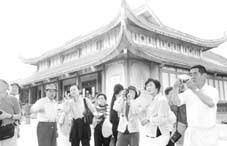
The countries in the Asia-Pacific region,
Vietnam included, all target China as a prospective tourism market.
However, it is not so easy for Vietnam to attract some 600,000 Chinese
tourists to the country annually.
By Vinh Tran
According to a report from the Yunnan Tourism Association (YTA),
70,000-80,000 Yunnan people (of the total population of 42 million of
the province) take outbound trips every year, mostly to Southeast Asian
countries such as Thailand, Malaysia and Singapore. The number of Yunnan
visitors to Vietnam was a mere 4,500 in 2000, and the number of
Vietnamese guests visiting Yunnan by train was just 2,000.
Le Dai Tam, director of the Hanoi branch of Vietnamtourism, says one of
the reason for the increase of Chinese visitors coming to Vietnam by
airplane is the slow passport granting in Yunnan as the guidelines have
not been implemented in all localities of the province. YTA members say
the obsolete railroad network from Yunnan to Lang Son, the northernmost
province of Vietnam, which was built long ago following an ancient
French technology, disappoints most travelers. But the main reason
voiced by the Chinese partners is Vietnam's entry permit fee. Luu Thuong
Vu, chairman of YTA, says the cost of US$50 (approximately 400 reminbi)
is too high and unfair for Chinese citizens touring Vietnam with their
passports. Moreover, the fact that there is no consulate agency in
Yunnan while the Vietnamese Embassy in Beijing is too far has caused
difficulties in time and money for Chinese travel agencies wanting to
open tours to Vietnam.
Truong Bao Quy, deputy head of the Yunnan Tourism Administration, says
service fees in Vietnam are many times higher for Chinese tourists.
"On a same tour, why do local visitors have to pay less than
foreign visitors do? And why do visitors traveling by train receive less
incentives than those traveling by airplane?" Quy wonders. It is
worth noting that Chinese visitors to Ha Long Bay and Cat Ba Island
spend only 35 reminbi a person on average; the corresponding figure is
200-300 reminbi in Thailand, as cited by Chen Chu Hui, director general
of the Yunnan Travel Agency. Chinese travel agencies also complain about
the similarity in tourist products.
A recent survey of the average expenditure of foreign tourists in
Thailand, conducted by the Tourism Administration of Thailand (TAT),
indicates that the most generous spenders are Japanese and Chinese
guests. A Japanese visitor spends some US$47 a day while a
"real" Chinese visitor spends US$56 daily in Bangkok. The
"real" Chinese tourists that TAT is aiming at are those who
come from the northern part of China such as Beijing and Shanghai.
Chinese tourists accounted for half of the international visitors to
Vietnam over the past few years. In a bid to tap this potential market,
Vietnam Airlines opened the Hanoi-Beijing route two months ago, so far
attaining an average occupancy rate of 50%. The Hanoi-Kunming route has
also been opened with three flights a week. The Vietnamese tourism
sector has also attended CITM '2001, an international tourism fair in
Kunming.
All these efforts have opened new prospects for the tourism sectors of
the two countries. With proper policies, the Vietnam tourism sector will
achieve its set target as Chinese tourists will choose Vietnam, the 15th
destination, as their second homeland.
Know More about China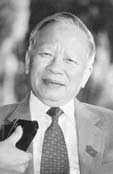
Belonging to the first generation of Vietnamese
students to study in China and having returned there many times for
work, Deputy Prime Minister Nguyen Cong Tan knows a lot about the
country. Following are some of his opinions about this market.
By Thai Thanh
"The whole world predicts China's admission to the World Trade
Organization (WTO) would cause fluctuations for the world's economic,
trade and investment situation. However, I just want to talk about the
agricultural influence.
China is an agricultural power and has some of the world's top
agro-products. In addition, China is also an import power. China imports
nearly US$30 billion worth of agro-products annually and Hong Kong
imports about US$15 billion. In the meantime, Vietnam exports only
US$4.3 billion worth of agricultural, forest and aquatic products.
Joining the WTO, China will have to open its market (and so will
Vietnam). We will have to find China's strong agro-products with which
we cannot compete in order to avoid wasteful investment.
In my opinion, these items include temperate fruits like apples, pears
and grapes. We should not invest big money in growing these fruits.
Another strong commodity in China is cotton. Chinese cotton has a very
high output; it has lower prices and higher quality compared with
domestic cotton. Chinese cotton yields more than three tons of seeds per
hectare while ours is under one ton per hectare. Even our textile
industry likes to import Chinese cotton because of cheaper prices. China
is also the world's leading producer of silk. China can create great
breeds of silkworm. Will the Vietnamese silk industry be able to stand
firm?
Another traditional commodity in China is pharmaceutical materials,
which have the No. 1 position on the global market. When we open our
market, it will be flooded with Chinese pharmaceutical materials. I
think we should not spend much time producing these four items and have
to make careful calculations so that we can both avoid being wasteful
and be able to increase our competitiveness.
In fact, China also produces agro-products which are our specialties but
their prices are higher, so we have an advantage and should not be
afraid of the competition. These are rice, rubber, coffee, pepper,
cashew nuts, tea, rambutans, durians, star apples, and aquatics. All of
these are more expensive in China than in Vietnam.
China currently has a gross domestic product (GDP) of over US$1
trillion; this figure doubles every 10 years. Chinese people will have
greater demand for goods, and this will be a big export chance for the
Vietnamese agriculture. The matter is whether our products are able to
compete with products of other ASEAN countries on the Chinese market.
We have one weakness: we border China but do not conduct large-scale
research in the country; there is a great deal of information about the
market, business practices, and businesses of China but we are
neglectful of the research. Over the past 10 years fewer people have
studied Chinese, China hasn't been researched, and not much information
is exchanged between the two countries. Therefore, we do not have many
people with profound knowledge of China's economy and businesses, and
have not been able to establish trade relations with Chinese partners.
We have just sold goods to the southern provinces of China yet no one
understands the northern provinces. I think we must establish a team of
experts on the Chinese market because this country's economy is still
developing and will become an important part of the world's economy. In
addition, we have not yet created characteristic Vietnamese commodities
which can be remembered by the Chinese. So far, the Chinese just know
Ben Tre coconut candies, Hai Duong green bean cakes and Phu Quoc fish
sauce. We must build a commercial agriculture with many trademarks in
order to penetrate this market.
I hope that we can seize just 10% of the value of Chinese agricultural
products."
|