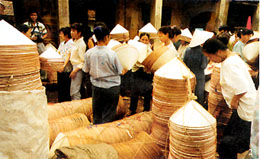
Chuong market: non goes from here to other parts of Vietnam and other countries.
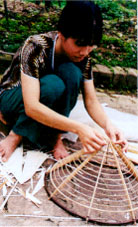
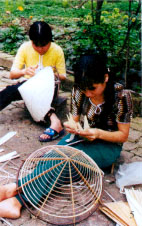
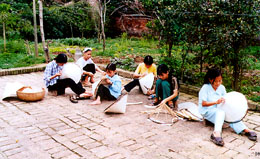
The non makers like to work in a group.
product hat
vietnam / nhân dân / product / hat
Product
Chuong village non
|
|
|
|
Chuong market: non goes from here to other parts of Vietnam and other countries. |
The non makers like to work in a group. |
The non from Chuong village in Ha Tay province enjoys quality and craftsmanship status.
Chuong is probably the best known non-making village in Vietnam, but no locals can tell who started the craft or when it was started. However, the oldest artisans say that for centuries the village used to offer the Chuong non as tributes to queens and princesses, not to mention that it has continued to be an object women, especially young girls, across the country love to possess.
Simple as the Chuong non may look, its making requires much time, labour, skill and talent. Different from the non made elsewhere, the Chuong non is the joint product of several neighbouring villages: Chuong sew the non, Lua makes the working frames, Don Thu whittles and polishes the hoops, and Dau Te spins the threads - or at least it did in the old days, natural fibres having been replaced by nylon. There's even a folk ditty that goes:
Palm-leaves from Xuan Phuong, pretty working frames from Lua.
And golden threads of the Creator, all to make the Chuong non.
|
|
|
|
|
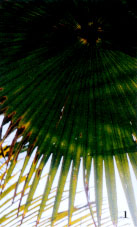
A fresh palm-leaf. |
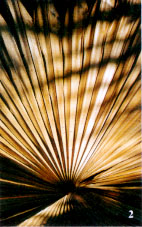
A dry palm-leaf. |
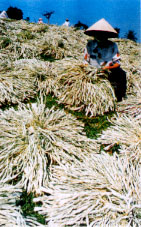
Drying palm leaves. |
Following the above division of labour, non-making in Chuong village begins with the selection of the right palm leaves. Villagers buy green palm leaves from the local market and dry them in the sun for several days until they turn white. The leaves must then be flattened before they can be used. They are placed on heated ploughshares and their creases are quickly smoothed out with a piece of cloth. If the artisan is not careful or skilful enough, the leaves may become brittle, wrinkled or torn.
|
|
|
|
|
Arranging bamboo hoops on a working frame. |
Selecting palm leaves. |
Trimming the palm leaves. |
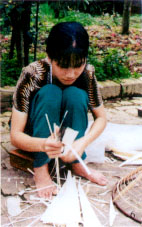
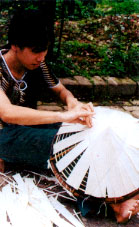
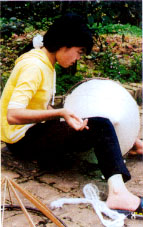
When the leaves are ready, the artisan can actually begin making the non. First he or she puts the hoops and the leaves together on the working frame. The Chuong non usually has only 16 hoops while the non from Thanh Hoa, Nghe An and Ha Tinh has 20 hoops. The artisan has to make sure that the leaves, which overlap each other, are evenly spread over the hoops. Only then does he or she start sewing the non with fine nylon threads. This is not an easy task as the stitches have to be exactly equal along each hoop. The finished non is then dried with sulphur to give it a white gloss and to prevent it from growing mould.
The range of the non made by Chuong villagers has also changed over time. In the past they used to make such non as the large flat ba tam, the medium-size and the non make from feathers. Since the 1940s, the villagers have stopped making the other types of non and engaged in producing mainly the conical palm-leaf non. Present-day Chuong villagers, from white-haired old people to little children, from slender young girls to sturdy young boys, all are absorbed in making non. The 2,500 house-holds of the village turn out 8,000 non a day.
|
|
|
|
|
Placing palm leaves on the working frame. |
Sewing the non. |
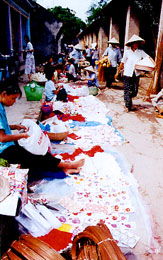
Selling decorations for the non. |
The Chuong market takes place on the 4th, 10th, 14th, 20th, 24th and 30th days of each lunar month. From the Chuong belfry, one can see a sea of white non below. The Chuong non are sent from this market to other provinces of the country and shipped overseas to Thailand, Japan, China, and Europe. It is, however, a shame that such a fine product as the Chuong non is sold at such a dirt-cheap price: VND 3,000 to 5,000 each. Chuong villagers nevertheless comfort themselves with the thought that they are still lucky enough to have a stable source of income from their traditional craft.
By HOANG ANH DUONG
(Vietnam Cultural Window)