|

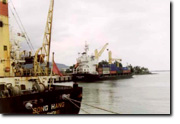
A port worker.
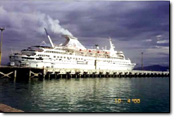
A foreign tourist ship
moored
at Tien Sa Port.
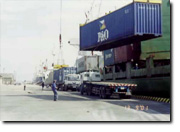
Unloading containers.
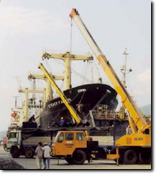
Han River Port.
|
A
very long time ago, Da Nang was an important port of Vietnam. Covering
an area of 12 sq.km, Da Nang Bay, 10-17 m deep and safe, was an ideal
anchorage for ships and boats. Located in central Vietnam, Da Nang City
lies on the transport system of land routes, railways, waterways and
airlines of the whole country and to other regional countries. It has a
modern communication system, which serves as a gateway to the world. At
present, it is an economic hub and the biggest city in central Vietnam.
It has large factories involved in textiles, consumer goods, processing,
mechanical, and construction material industries. Therefore, Da Nang
Port has an important role in the economic development of the central
area and Tay Nguyen (Central Highlands) as well as in commercial trade
with southern Laos and northeastern Cambodia. It is also an important
port for tourist travel and transportation on the Asian sea route.
Han
River Port has a wharf, 4 km long and 6.2 m deep, a container yard of
10,350 sq.m and two warehouses of 2,474 sq.m. It can accommodate ships
up to 5,000 DWT and container and passenger ships. Its handling capacity
is one million tonnes a year. Not far away is Tien Sa Port which lies on
Da Nang Bay. It has a wharf 897m long and 12m deep, a commodity yard of
115,000 sq.m and warehouses of 20,290 sq.m. It can accommodate ships up
to 30,000 DWT and specialized ships, such as RORO, container and
passenger ships and ships carrying super long and heavy goods. Its
handling capacity is three million tonnes a year. After upgrading this
port will have a capacity of six million tonnes a year.
Da
Nang Port’s Deputy Director Nguyen Xuan Dung, a man with a
self-confident smile and the voice of a native of Quang Nam Province,
talked about the activities at the Port. Although the volume of goods
increased the port’s growth rate was not stable. To solve this problem
the Port gradually replaced the old equipment, bought more equipment to
increase the handling capacity and reformed the management. In the
coming years Da Nang Port will implement multi-form transportation to
enable the passage of container ships to other countries. The trend of
global integration requires a quick handling of containers, so a
computerized control centre to serve the activities at the port will be
established. That is included in the Tien Sa Port-upgrading project,
capitalized at USD 200 million with two phrases from 2001 to 2004. When
the project is completed, Tien Sa Port will be able to accommodate ships
up to 35,000 DWT and container ships up to 20,000 DWT and ensure their
absolute safety.
Da
Nang Port, the last terminal of the trans-Asia route on the “East-West
Corridor” line will attract more investors to do business, helping to
bring the central region out of poverty.
|